
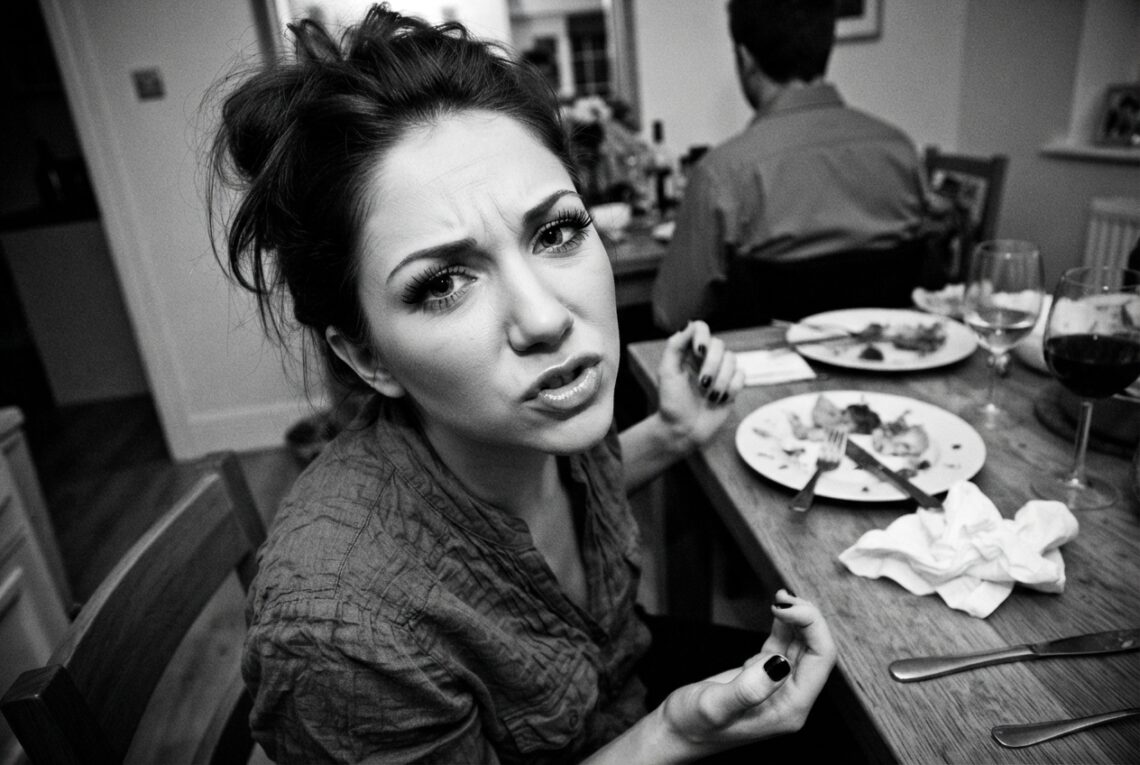
Sunday Lunch Arguments And The People Who Actually Stay
I have always thought Sunday lunch is a poor place to test a theory and an excellent place to test a person. The gravy is already making demands. Someone has overcooked the carrots on purpose because that is how their mother did it. There is a bottle on the table that is doing more work than it should. And then, with almost no warning, somebody mentions the news.
It starts small. It always does. A throwaway line about a minister, a headline, a policy that has reached Essex in the way weather reaches Essex, which is to say late, loudly, and with everyone having an opinion before the facts have sat down. I watch the temperature change the way I watch a data set start to lean. One comment. A correction. A joke that is not quite a joke. Then you are in it.
I am not against an argument. I like a well structured one. I like watching someone hold a position without reaching for cruelty as a shortcut. What I cannot stand is the person who treats disagreement as a chance to become a different animal. You know the type. Charming over the starter. Absolute menace by the roast. They call it banter. I call it a personality that only works when nobody is asking it to be kind.
Loyalty, as far as I am concerned, is not the speech you give after the row. It is who is still in the room when the record goes on.
My family does Sunday lunch the way a lot of Essex families do, which is with genuine affection and a slightly dangerous confidence that everyone can take a hit. Hard work is respected. A good night out is respected. Being able to hold your own at the table is respected, sometimes more than it should be. I grew up watching people love each other in a practical way. Plates refilled. Lifts offered. Someone driving you home even after you had been, by any reasonable measure, a bit much. That kind of care does not always come with soft language. It comes with presence.
I used to think the loudest person at the table was the most loyal. I was young and I had not yet learned to separate volume from devotion. Some people make a performance of sticking by you. They announce it. They keep receipts. They want credit for not abandoning you, which is a strange thing to want credit for, like wanting applause for not dropping a child. The people who actually stay are usually less theatrical. They rinse a glass. They change the subject without pretending the subject never happened. They put a record on because the room needs a different temperature, not because they need to win.
There is a particular Sunday I come back to, not because it was cinematic, but because it was ordinary enough to be true. The table was too small for the number of opinions on it. Someone had made too much food, which in my family is not a mistake so much as a moral position. We had already done the easy talk. Work. Who is seeing whom. Whether Southend in winter is bleak or beautiful, and the correct answer is both, obviously, depending on whether you brought a coat and a sense of humour.
Then politics arrived, as it does, like a relative who was not invited but knows where the spare key is.
I will not recap the argument. You have had your own version. Two people who love each other, or at least have to get back in the same car later, suddenly speaking as if the other one has become a symbol instead of a person. I remember the heat in my face more than the content. I remember thinking, with the unhelpful clarity of someone who has studied attachment and still lives in a body, that this was no longer about the topic. It was about whether anyone in the room could stand being unseen for five minutes without turning it into a verdict.
I have an anxious-secure lean, which is a polite way of saying I notice tone shifts the way other people notice draughts. A paused fork. A laugh that comes half a second too late. The way someone’s shoulders do a small retreat while their mouth keeps going. I can name the pattern and still feel it. That is the inconvenient part of knowing psychology. It does not make you above the weather. It just means you can identify the cloud while you are getting rained on.
Anyway. The row did what rows do. It found the old bruises and pressed, not always on purpose. Someone said you would think that. Someone else said well someone has to live in the real world. I said something precise and not entirely helpful about motivated reasoning, because of course I did. There is a version of me that cannot resist bringing a concept to a knife fight. It is not always my most charming quality. It is, however, very me.
What I remember next is not the winning line, because there was not one. What I remember is the scrape of a chair, the decision not to leave, and my cousin, of all people, going over to the speaker as if the afternoon could still be salvaged by the right track. He did not make a speech about unity. He did not say let’s agree to disagree, which is a phrase that makes me want to lie down. He just put a record on. Something with a bit of warmth in it. Something that made the room remember it had a body, not just a collection of positions.
That is loyalty, I think. Not the absence of conflict. The refusal to let conflict become the whole house.
People get sentimental about chosen family, and I understand why. Blood is an accident with a long receipt. Friends are an edit. The phrase chosen family can sound like a consolation prize if you say it wrongly, as if you ended up with the understudies because the main cast disappointed you. I do not experience it like that. The people who stay after the politics row are not a backup plan. They are the point. They are the evidence that you can build a life with more intention than you were handed.
I have university friends who became that. Wivenhoe Park in the background of too many conversations that went on longer than they should have. Library lights and the walk home because neither of you wanted the thought to end. Those friendships were not all gentle. Student life is a poor finishing school for emotional elegance. People vanish. People get new selves and forget to send a note. People treat closeness like a term-time subscription. The ones who lasted were not always the ones I had the most fun with on a Wednesday. They were the ones who could survive a version of me that was tired, sharp, or inconveniently earnest.
There is a girl from my course, maths first, who still texts me the way some people keep a plant alive, which is to say regularly and without making a production of the watering. We have disagreed about almost everything except the fact that we are staying. She once told me I was being intellectually vain in an argument, which was rude and accurate. I did not like her for twenty minutes. Then I liked her more, because it is a rare person who will tell you the truth and still come with you for chips afterwards.
That is the test I trust now. Not who is delightful when the lighting is good. Who remains when you have been slightly unbearable and the gravy has gone cold.
I should say, because honesty matters to me, that I have left rooms too. Loyalty is not the same as endurance without judgement. There are arguments that reveal a cruelty you cannot keep sitting beside. Banter that is actually contempt. A person who uses politics as cover for the pleasure of looking down on someone. I have no interest in being loyal to that. Self possession is also a form of staying, just with yourself.
The culture around women right now is full of talk about peace, and I am not against it. Peace is a serious standard. I have watched too many clever women treat depletion as proof of love. Still, I do not want a life so smoothed out that nobody is allowed to be wrong at lunch. I want people who can survive friction without becoming unkind. I want the record after the row. I want the second pot of tea. I want the person who says that was a bit much and then asks if you want a lift.
There is a mathematical way I think about this, and I will only indulge it for a moment because I can feel you rolling your eyes, which is fair. People treat loyalty like a binary. Stay or go. In or out. Real life looks more like a distribution. Most relationships cluster around a messy middle of showing up often enough. The tails are dramatic. The grand gesture. The sudden disappearance. What I am interested in is the centre of that curve. Repeated presence. The unglamorous probability that if the afternoon goes badly, they will still be there when the kettle boils.
I notice it in small data. Who texts the next day without rewriting history. Who can say I was sharp earlier without turning it into a speech about their childhood. Who remembers that you take the Yorkshires seriously and that you hate being told you do not seem like you are from Essex, as if intelligence required a different postcode. Who still wants you, not the polished version of you that never misses and never snaps.
Wanting is the part people skip when they talk about loyalty. They make it sound like duty. Duty is fine. I am not above duty. But the people who actually stay are the ones who still have appetite for you after they have seen the unflattering angle. After you have been too much about a headline. After you have brought attachment theory to a conversation that only wanted salt and a bit of gossip. They look at you over the wreck of the roast and think, yes, still her.
I find that unbearably moving, which is probably why I write about it as if it were a thesis.
Sunday lunch is a good laboratory because it combines all the variables I care about. Food. History. Status games. Love. The slight pressure of being observed by people who knew you when you had a milder accent and less certainty. You cannot perform indefinitely in that setting. Eventually your real timing comes back. Eventually you reach for the same argument you reached for at nineteen, or you surprise yourself by not reaching for it. I like watching who has updated their model.
My father will argue with anyone, including the radio. My mother will let it run for a while and then start clearing plates with the energy of a woman who has decided the nation can wait until the dishwasher is loaded. I used to think that was avoidance. Now I think it is a form of care. Not every conflict is improved by extra minutes. Some rooms need a practical interruption. A record. A walk. A reminder that we are still, inconveniently, fond of each other.
Essex gets caricatured as loud and unreflective, which is lazy. There is a lot of unshowy intelligence around those tables. People who can read a mood without naming it. People who will drive across the county because someone had a bad week. People who will wind you up and then defend you the second an outsider tries the same joke. That last one matters. In house teasing is not the same as being hung out to dry. The difference is loyalty with a sense of proportion.
I have a low tolerance for being looked down on because of where I grew up. Sunday lunch is where that intolerance first learned its manners. You can disagree with me. You can tell me I am wrong about the policy, the probabilities, the whole shape of the thing. What you cannot do is use my background as a substitute for an argument. I will notice. I will go quiet in that precise way that means I am collecting evidence. And I will remember, later, whether you repaired it.
Repair is the unfashionable twin of passion. Everyone wants the feeling of being chosen. Fewer people want the work of coming back after you have been clumsy. I am romantic about this, I know. I am also practical. A relationship, friendship included, that cannot repair is just a pleasant coincidence with an expiry date.
When I say chosen family, I mean the people with whom repair is possible. The ones who can stand the politics row and still put a record on. The friend who will say you were doing that clever thing where you win and lose at the same time. The relative who rolls their eyes and then saves you the last potato. The person who does not need you to be easy in order to keep wanting your company.
There was a date I had, years ago, that I thought might turn into that kind of staying. We talked for three hours about free will and determinism, which is either a brilliant sign or a warning label, depending on how much you like living inside questions. He was good at listening. He remembered details. I liked his mind. Then, later, when a small disagreement arrived, he went strangely unavailable, as if friction itself were a character flaw in me. I did not need him to agree. I needed him not to disappear into mystery and call it depth. Mystery, in my experience, is often just poor communication in a nicer coat.
I laughed at myself afterwards, because of course I did the anxious bit. Counted the hours. Replayed the tone. Ran the probabilities. Then I recovered, which is the other half of my pattern, the part I am proud of. Self awareness is only useful if it gets you back to the table.
The older I get, the more I want my life organised around the people who can tolerate a full Sunday. Not the highlight reel. The whole awkward afternoon. The overdone carrots. The opinion that should have stayed in draft. The moment someone puts music on and the room remembers it is allowed to be fond again.
I do not think loyalty has to be grim. That is a misunderstanding sold by people who confuse suffering with meaning. The best version is almost light once you are through the weather. Someone refills your glass. Someone takes the piss out of the way you explained cognitive dissonance to your uncle. Someone says come on, we’re going for a walk before the evening news starts another fire. You go. Your body comes back. You are still chosen.
There is a private list I keep of nights that changed the weather inside me. Not all of them were glamorous. Some were just the relief of realising I did not have to perform peace for people who only love me when I am convenient. A winter seafront. Heels in one hand. Cold air that made everyone kinder. A campus walk at an hour that made the park look theatrical. A kitchen, later, too many bodies, someone finding a record that made the argument look smaller than it had felt.
Sunday lunch belongs on that list more often than people admit. It is not fashionable. It will not trend. It is one of the last places where you find out whether your relationships can survive you having a mind and a history at the same time.
I think about teaching this, in the loose way I teach anything. Not as a lesson with slides. As a habit of attention. Notice who stays. Notice who needs an audience for their loyalty. Notice who can be wrong without becoming cruel. Notice who still makes you a plate. Those are better metrics than most of the ones we use when we talk about love.
If you want a slightly sharper frame, try this. Attachment patterns show up beautifully around a dining table. The person who escalates to keep you close. The person who shuts down and calls it being above it all. The person who can stay in the discomfort without turning you into the enemy. I know which one I am when I am tired. I know which one I am trying to be. I have a lot of time for anyone else doing the same work in public, over gravy, with no chance to edit.
Dry as this may sound, I do not want a life full of people who agree with me. Agreement is pleasant and often shallow. I want people who can bear the sight of me in disagreement and not revise my whole character. I want to be allowed to care too much about a point and then come back to myself. I want them to still fancy my company after I have been a nerd about probability at the worst possible moment.
That is the romance in it, for me. Not candles. Not a speech. The continued appetite.
Chosen family gets talked about as if it were a trend. I think it is just what happens when you become old enough to stop confusing intensity with safety. You look around the table and do a quiet audit. Who is still here. Who puts the record on. Who wants you after the row has made everyone briefly uglier than they intended.
If that sounds unglamorous, good. Glamour is lighting and a well cut dress, both of which I like. Loyalty is the bit that gets you home. It is the person who argues with you, thinks you are a bit much, loves that you are a bit much, and still saves you a seat when the next Sunday comes around.
I will keep going home for those lunches. I will keep bringing the slightly inconvenient brain. I will try not to use psychology as a party trick, even when the opening is right there. I will notice who stays. I will try to be someone who stays without making a martyr of it. And when the politics has done its predictable damage, I hope there is still a record nearby, and a person who understands that the point was never winning.
The point was the room. The people in it. The fact that after all that heat, somebody looked at you and decided you were still worth the rest of the afternoon.

nikkiessex
I am Nikki. 40 years old. Essex-born. I trained in mathematics and psychology, then made a living in behavioural work: people, patterns, the quiet data underneath what we say we want. I teach the same things I write about. How minds lean. How loyalty shows up after the row. How to keep a clear head without going cold. I have been writing on the internet for five years. Not as a brand exercise. As a way of thinking in public. If you are new, start with the pieces that feel like a table you already know. I will meet you there.


You May Also Like

I Will Analyse the Film Then Ask What You Felt

I Want a Partner Not a Project I Have to Manage