

Complimenting a Stranger Jacket Is Still My Favourite Sport
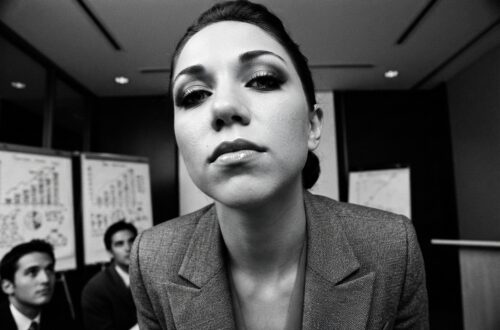
I will tell a woman in a bathroom queue that the cut of her jacket is perfect, and I will mean it in the unfashionable, unstrategic way. Not as networking. Not as a soft opener to ask where she got it so I can go and buy the same one. Just because the jacket is doing something kind to her shoulders and she should get to hear it from a stranger before the night swallows the moment.
People treat that instinct like a personality quirk, or worse, like evidence that I am a bit simple. Warmth gets coded as naivety if you grew up anywhere the country has already decided is loud. I grew up in Essex. I watched the cartoon get drawn over women who looked a bit like my cousins and sounded a bit like my aunties, and I made a private decision that I would be the counter-example without becoming cold in the process. Two degrees. No performance of stupidity. No white stilettos as identity. I kept the part where you speak to people in queues. That part was never the joke. The joke was always the assumption that friendliness and intellect cannot share a coat.
A bathroom queue is one of the last honest rooms left in nightlife. The lighting is usually unflattering, which I resent on principle and forgive in practice. You are holding a drink you should have left at the table. Someone’s heel is slightly dying. The music is a rumour through the door. In that little corridor of women doing the unglamorous work of being in public, a specific compliment lands differently than it does on a pavement. It is not a performance for men. It is not content. It is one woman saying to another, I saw you. Not your availability. You.
I care about the difference. Generic praise is just social lubricant. “Love your outfit” can mean anything from I am being polite to I have not actually looked. Specificity is the compliment that behaves like attention. The seam that hits at the right place on the waist. The way a blazer makes her look like she arrived on purpose. The red that should be too much and is not. If I am going to open my mouth in a queue of strangers, I want the sentence to prove I used my eyes.
Women are starving for that kind of looking, and we pretend we are not because wanting to be seen has been made to sound like a moral failing. We have spent a decade being told that the highest feminine achievement is not needing anything from the room. I understand where the advice came from. Need has been used against us. Approval has been used against us. A certain kind of male gaze will take any opening and call it invitation. So we trained ourselves to walk through nights as if we were self-contained units, glossy and unbothered, giving nothing away, asking for nothing back. It is a reasonable armour. It is also a lonely way to get dressed.
I make an effort with my appearance because I enjoy it, not because I require a referendum. That distinction matters to me and I will keep repeating it until it sticks. A well-cut dress is not a plea. Good hair is not a personality hole. I like lighting that does faces a favour. I like a jacket that feels like a decision. None of that means I am waiting for a stranger to complete me. It means I live in a body and I would like the body to feel inhabited. When another woman notices the inhabiting, something in me stands up a little straighter. I try to offer the same thing back. It is a small economy and it works.
Essex warmth, the refined version, is not the cartoon of shrieking across a club. It is approachability with a spine. You can start a conversation in a bathroom queue and still have two degrees and a low tolerance for being looked down on. You can compliment a jacket and still leave if the conversation turns cruel. You can be direct without being vulgar. I kept all of that on purpose. People who have never had their origin treated as an intelligence test do not understand why the keeping matters. They think friendliness is just weather. For some of us it is a refusal. I will not become frosty to prove I am serious.
There was a night in Chelmsford that started in a bar and ended in a club that no longer exists, which is how most of the good nights are stored now, as buildings that have been turned into something unlovely. My feet hurt in the honest way. In the queue for the toilets a girl in a black jacket stood with her arms folded like she was bracing for weather. The jacket had this clean line through the shoulder, the sort of cut that makes you look taller without begging. I told her. She looked startled, then pleased, then a bit suspicious, as if kindness from a stranger might be a trick with a timeshare attached. Then she said, I nearly did not wear it, I thought it was too sharp for this place. And there it was. The whole stupid machinery of women talking themselves out of their own taste because a room might not be grand enough to deserve it.
I think about that sentence more than the night itself. Too sharp for this place. As if a jacket had to apologise for being precise. As if we should dress down to match the sticky floor so nobody accuses us of trying. Trying is treated like a crime if you are a woman from the wrong postcode. You can wear something well-cut and still be told you “do not seem like you are from Essex,” which is a sentence I dislike with a heat that surprises me. It is meant as a compliment. It is actually a little act of theft. It says the good thing about you cannot belong to the place that made you. I smile less at that now. I would rather be from Essex and accurate than from nowhere and approved.
University complicated the warmth, or tried to. Colchester, Wivenhoe Park, the particular collision of serious study and student nightlife that I still think of as the only honest version of being twenty. There were rooms where an Essex accent, even the mild one I used to have, got treated as a forecast of shallowness. I outscored those rooms. I also watched myself, for a term or two, getting quieter in queues. Not because I had become shy. Because I had started to believe that warmth would undo the proof. As if friendliness could reverse a first-class mark. It is embarrassing to admit how close I came to buying that. Intelligence does not require frost. I wish someone had written that on the inside of my folder.
The bathroom queue at Sub Zero during Freshers was a different country. UV paint. Sticky floor. Girls who did not know each other’s names doing one another’s eyeliner with the concentration of surgeons. Nobody was performing mystery. We were too new and too possible. I danced with people I forgot by morning and still remember the feeling. That feeling included the casual generosity of women noticing each other without making it a project. I did not have the language then. I do now. Attention without claim. It is one of the best human tricks we have and we keep giving the credit to romance.
Romance gets the essays. Friendship does the load-bearing work. A twelve-minute friendship in a ladies’ queue is not nothing. Temporary does not mean fake. Some intimacy is seasonal and still true. You may never see her again. You may see her three years later in a supermarket in Southend and have that split-second of almost-recognition that makes you both laugh. Either way, the jacket compliment did a job. It put a small, specific kindness into a night that might otherwise have been only noise and calculation.
I am not naive about men in this picture. A certain kind of man treats female warmth as public property. He hears you speak kindly to a stranger and decides you are available for commentary. He calls it banter when it is just entitlement with a pint in its hand. My warmth is not a vacancy sign. I can compliment a woman and still have a very low tolerance for cruelty dressed as humour. I can be approachable and still leave. Approachable is not the same as accessible to everyone. That distinction should not be this difficult, and yet here we are, still teaching it.
What I will not do is let the existence of those men freeze the rest of the room. If I stop speaking to women because some men cannot tell the difference between friendliness and consent, then the wrong person has set the temperature. I refuse that. The female audience I am writing to already knows the calculation. You have done it in your head on a pavement. Is this safe. Is this worth it. Will this be taken down and used as evidence that I am too much. I cannot dismantle the whole calculation in one essay. I can only say that I still think the compliment is worth the risk more often than it is not, especially when it is woman to woman, in a queue, with no audience that matters.
Style is not trivial in this. People who call clothes shallow are usually people who have never had to think about how they are received. A jacket is a piece of cloth and also a thesis about how you want to enter a room. When I tell you the cut is perfect, I am not reducing you to fabric. I am recognising the decision. I know what it costs, in money and in nerve, to wear the thing that makes you feel like yourself rather than the thing that will offend nobody. A dress that makes you feel like yourself is one of my private measures of a life going right. So is the woman who notices it on you without turning it into a competition.
Competition is the poison that gets poured into female looking. We are taught that if another woman looks good, something has been taken from us. It is a stupid piece of maths. Beauty is not a closed set. A room can hold more than one person who took care. I can want a well-cut jacket of my own and still be genuinely glad about yours. In fact the gladness is part of the pleasure. It is proof that my taste is not only a survival strategy. It can also be delight.
There is a psychological term for why a specific compliment works so well, and I will use it because it fits. We are starved of accurate reflection. Most feedback women get in public is either evaluative in the male-gaze sense or so vague it could have been generated by a polite machine. Accurate reflection is rare. When someone names the actual thing, your nervous system files it under being known, even if the knowing lasted twelve seconds. That is why you remember the stranger in the queue and forget the man who said “you look nice” without lifting his eyes from your chest. Specificity is respect. Generality is often just noise.
I give excellent, specific compliments. It is one of my quirks and I am not interested in sanding it down. I will notice the lighting doing your cheekbones a favour. I will notice that you chose the dress that moves when you dance instead of the one that photographs well from the front and dies at the side. I will notice effort that is for you, not for the algorithm. If that makes me sound earnest, good. Earnest is allowed. I am bored of women apologising for being sincere as if sincerity were a provincial accent.
Southend seafront after a messy, joyful night will always be the image I reach for when someone asks why I still bother. Cold air. Heels in one hand. The sea looking theatrical, which the sea does without trying. You are tired in the earned way. If a friend turns to you in that light and says the jacket was the right call, you feel the night settle into something you get to keep. Place stores feeling better than photographs do. So do sentences. I go home to Essex often enough to remember that the warmth was not a phase I grew out of at university. It was a method.
Work complicates it in a different direction. I use both degrees now, the mathematics and the psychology, in a role that cares about patterns in behaviour. You can spend your days looking at people as data and forget they would like to be looked at as particular. The queue is a correction. No spreadsheet. No hypothesis. Just a woman and a jacket and a sentence that does not need a citation. I need that correction more than I used to admit. Competence without warmth turns you into a very impressive locked door. I would rather be a door that opens on purpose.
There is a version of modern femininity that treats every social gesture as a brand decision. Will this make me look soft. Will this make me look try-hard. Will this end up in a story I do not control. I understand the fear. I do not live inside it. If a compliment I gave in a bathroom queue is the most reckless thing I do this month, my life is both safer and poorer than it should be. Reckless, in this case, means kind without an agenda. We have made agenda-free kindness look suspicious. That is a cultural injury, not a personal insight.
So here is the practical bit, because I know some of you are reading this with your arms folded, waiting for the rule. Look at women on purpose. Not to rank them. Not to borrow their faces for your own private unkindness. Look until you can name one true thing. Then, if the room is safe enough and the moment is not going to turn you into an inconvenience, say the true thing. Keep it short. Do not annex her night. Do not follow it with “where is it from” unless she offers. Let her have the pleasure without turning it into a transaction.
If she looks startled, that is information about the world, not about you. Many of us are out of practice at receiving accurate warmth from strangers. We scan for the catch. Give her a beat. Smile like a person, not like a hostess. Then go back to washing your hands, which is, after all, why you were both there.
And if you are the woman in the jacket, take it. Do not swat it away with “this old thing” or “it was twelve pounds” or “I was not even going to wear it.” Those deflections are little abandonments of yourself. You do not have to perform humility to stay likable. Likable is not the assignment. Accurate is closer. Say thank you. Mean it. Walk back onto the dance floor with the sentence in your pocket. It will last longer than the song.
I am a hopeless romantic about this, which will not surprise anyone who has been paying attention. I fall for people who can match me intellectually and physically, yes. I also fall a little for rooms where women are not treating one another like competition footage. A night out is not evidence you are trivial. Sometimes it is how a serious woman metabolises joy. The jacket is part of the joy. The queue is part of the joy. The stranger who used her eyes is part of the joy. None of that cancels the spreadsheet brain. It keeps the spreadsheet brain from becoming the whole animal.
I still count tiles when I am anxious. I still notice probability in ordinary life. I still analyse a film’s attachment dynamics without being asked. Those habits make me precise. They do not make me cold. If anything they make the small human gestures more valuable, because I can see how rare accurate kindness is once you start measuring. High extraversion, in the boring personality-test sense, means I am energised by people. Fine. Call it that. I call it refusing to treat other women as scenery.
The stereotype they built of us was loud, orange, unintelligent, promiscuous. I am none of those things. I kept the unashamed enjoyment anyway. Nights out. Style. Dancing until I am tired. Sex that does not pretend it is nothing. And this, the part that looks minor until you live without it: the willingness to say, to a woman you will probably never see again, that the cut is perfect.
Warmth is not naivety. Naivety is believing that if you make yourself smaller and quieter and harder to compliment, the world will finally take you seriously. I tried a version of that. It did not make me more intelligent. It only made the nights poorer. I would rather be the woman in the queue who speaks. I would rather be the woman in the jacket who lets herself hear it.
Wear the sharp thing. Say the specific sentence. Let the twelve-minute friendship exist without demanding it become a subplot. Approachability, kept on purpose, is one of the few Essex inheritances I have no interest in returning. It costs almost nothing. It pays in the only currency I still trust after midnight, which is the feeling of being seen as well as looked at, and of offering that same small, accurate gift before the door opens and the music takes you both back.

nikkiessex
I am Nikki. 40 years old. Essex-born. I trained in mathematics and psychology, then made a living in behavioural work: people, patterns, the quiet data underneath what we say we want. I teach the same things I write about. How minds lean. How loyalty shows up after the row. How to keep a clear head without going cold. I have been writing on the internet for five years. Not as a brand exercise. As a way of thinking in public. If you are new, start with the pieces that feel like a table you already know. I will meet you there.


You May Also Like

Winter Coast Salt Hair and Why Effort Still Matters
They Heard the Accent First Then I Outscored the Room