

Chips in the Taxi Queue After Dancing Until It Hurt
The club is gone. That is the first thing, and I keep wanting to start somewhere more elegant, but the building does not care about elegance. It was never elegant. It was loud and a bit sticky and the lighting did that unflattering thing lighting always does after midnight, and still I would put a good coat over a dress that made me feel like myself and walk into Chelmsford as if the night were a room I had a right to enter.
I am writing this for the women who have been told, at some point, that a night out is evidence. Evidence you are not serious. Evidence you are the cartoon. Evidence that the degree, the job, the careful mind, the attachment theory you can name in a seminar, all of that gets cancelled by chips in a taxi queue at an hour your lecturer would have called ungodly. I have two degrees. I still wanted the queue. Those facts have never cancelled each other in my actual life. They only cancel each other in other people’s stories about women from Essex.
A Chelmsford night, the ones that stayed, rarely began as a night. They began as a text that said come out, or a dress hanging on the door that had been waiting since Thursday, or the particular restlessness that arrives when you have spent too many hours being competent and your body starts asking for a different kind of maths. Beats. Steps. The count of songs until your feet hurt. I count when I am anxious. I also count when I am happy. The difference is whether I notice I am doing it.
We would start in a bar that thought it was being subtle. Warm light, a table you had to guard with a bag, the first drink that tastes like possibility and the second that tastes like you are committed now. Moulsham Street has always had that slightly theatrical quality, as if the pavement itself remembers being a Saturday. Duke Street too. Chelmsford is not London and it does not need to be. It is a city that knows how to do a night without asking your postcode to perform.
Then the club. I will not make a shrine of the name. You know the type if you had your early twenties in this county. Two rooms if you were lucky, a dancefloor that looked bigger after midnight, a DJ who understood that people did not come out to be educated. Popworld went in the end. Walkabout went. Places before that went and became flats, which is the most Essex ending I can think of: joy demolished for housing, memory left standing in the car park. Dukes had already passed into folklore by the time I was old enough to be in a room like that properly. The point is not the plaque. The point is the feeling of being newly possible in a space that will not last.
I danced until my feet hurt. That sentence is doing more work than it looks. Hurting is information. It means you stayed past the polite window. It means you stopped performing the version of yourself that leaves at a respectable time so nobody can say you overdid it. A serious woman is allowed to overdo joy. I wish someone had printed that on the back of my student card.
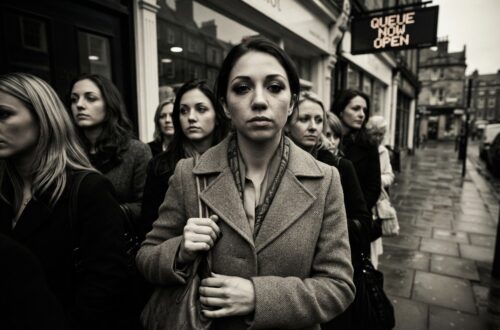
There is a particular Essex warmth that happens in the ladies. You will compliment a stranger’s jacket. She will tell you the shop, or the lie about the shop, and for twelve minutes you will be in a friendship that has all the intensity of a longer one and none of the admin. Then you will never see her again. People call that shallow. I call it seasonal intimacy, which is still intimacy. Women have always known how to make a queue into a living room. If you have ever stood under that lighting and felt chosen by someone who does not even know your surname, you already understand more about attachment than half the books.
I was not there to collect men. I was not there to perform the Essex girl they keep in a drawer for punchlines. I was there because my body likes music at a volume that leaves no room for the spreadsheet. Because I like a well-cut dress. Because dancing is one of the few activities where extraversion does not have to explain itself. High extraversion, if we are doing the inventory, is not the same as being loud for sport. It is being energised by people. It is walking into a room and feeling the charge instead of the threat. It is also knowing when the room has become unkind, and leaving without making a thesis of the exit.
Sex sometimes arrived later. Sometimes it did not. I am not going to tidy that into a moral. Nights out and desire live on the same street. Anyone who pretends otherwise is doing manners. What I will say, because I am talking to you and not to a panel, is that the nights that stayed in me were the ones where I felt seen as well as wanted, or seen instead of wanted, or simply seen by my own friends in the specific way women see each other when the music is too loud to lie well. Consent is not a mood killer. It is the difference between a story you keep and a story you have to recover from. I have had both seasons. I prefer the first.
Then the queue. This is the part people leave out of the recap because it is not glamorous and it is the part I love. You are holding your heels. Or you are not, and you will regret that in the morning in a way that is almost tender. The air has that Chelmsford cold that makes the sea, later, feel like a personality. Someone is too loud. Someone is crying about a boy who is not worth the salt. Someone is eating chips as if they were a medical intervention. They are. Salt and fat after dancing is aftercare. I will die on that hill in comfortable shoes.
The taxi queue is where the night tells the truth. In the club you can still edit. In the queue you are a woman with sore feet and a dress that has done its job and a mind that has come back online just enough to notice the sky. I have stood in that line after a messy, joyful stretch of hours and felt, not empty, not cheap, but completed. Like a sentence that found its full stop without becoming grim.
Chips. I will not romanticise the quality. They were fine. They were hot. They were shared badly. They were the opposite of a tasting menu and that was the point. A first-class mathematics degree does not require you to aestheticise every pleasure into small plates. Sometimes the correct unit of joy is a paper wrapper and a friend saying, can I have one, already taking three.
If you grew up here you know the suspicion that attaches to that image. Orange. Loud. Unintelligent. Promiscuous. The TOWIE-era cartoon that sat on the county like cheap foundation. Sugar Hut nights, the Brentwood ones, the rooms where the lighting was unflattering and the music was too loud and you still felt electric because you were with your people. I went to rooms like that. I also read papers. I also sat in Wivenhoe Park at two in the morning because a conversation would not end. The culture kept asking me to pick. I refused the pick. That refusal is the most Essex thing I have ever done, and it has nothing to do with white stilettos.
A night out is not a personality. It is a metabolism. You take the week, the emails, the carefulness, the way you hold a room with a proof and a story, and you run it through music until some of the static leaves. Women are allowed a nervous system. We are allowed to regulate with dancing instead of only with baths and journals and the respectable loneliness that gets praised as self-care. I like baths. I like journals. I also like a floor that sticks a little and a song I did not know I loved until it hit.
Colchester had its own version. FED Wednesdays after sports socials, cheap drinks, kit energy turning into something messier. Sub Zero and UV paint and Freshers Week, the sticky floor, the feeling of being new. Those nights taught me I could be intellectually exacting and still want a dancefloor. University of Essex was the collision I needed: serious study and student nightlife, neither cancelling the other. I did both. I did not pretend one was the apology for the other. If a lecturer heard the mild accent I used to have and assumed I was less serious, the night out was not the problem. The assumption was.
I think about competence in strange places. On a dancefloor competence looks like knowing where your friends are. It looks like clocking the man whose attention has a hook in it. It looks like drinking enough to be in the night and not so much that you outsource your judgement. Conscientiousness is not only for deadlines. It is how you get everyone into a taxi. It is how you text the one who went quiet. It is how you do not leave a woman in a bathroom queue who has started to look like weather.
People talk about clubbing as if it were the opposite of intimacy. I have found more honest conversation in a smoking area than in certain restaurants with good reviews. Cold air. Heels in one hand. A sentence you would not have said under kinder lighting. Then someone puts their jacket round your shoulders without making a speech about it. That is attachment in the wild. Consistency in small, unphotographed gestures. Being chosen for the walk to the rank, not just for the photograph at the start.
The sunrise is the part I keep. Not every night earned one. The ones that did felt like a receipt. You had spent yourself in a direction that was not productive and the sky still came up, which is either depressing or holy depending on how your feet feel. Chelmsford sunrise is not the Southend theatrical sea. It is quieter. It happens over retail and the backs of buildings and the particular grey that means you should have eaten earlier. It still counts. Earned is the word I used in the note for this piece, and I meant it. Some joy you have to stay long enough to deserve.
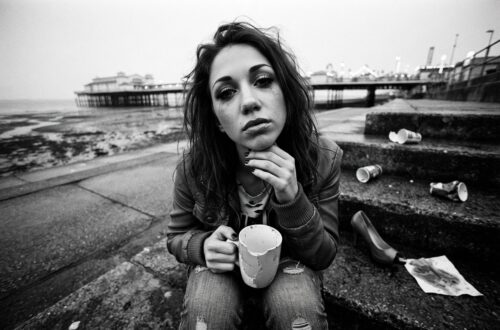
Southend came later in the same family of nights. Seafront, cold, the water doing too much, heels off, the feeling that place stores memory better than your camera roll. I go home to Essex often. That is not failure to leave. That is loyalty to a coastline and to the version of me that first learned how to be in a room. London dates have their hotels and their lighting. I like those too. I like choosing the restaurant and then choosing the room. I also like the unchosen beauty of a taxi queue that smells of vinegar.
If you are a woman who has been talked out of nights like this, I want to say the quiet thing. You do not have to become austere to be taken seriously. Austere is just another performance, and it is often a class performance wearing intellectual clothes. There is a type of person who hears Essex and nights out and chips and decides they know your reading list. Let them. Then go dancing anyway. Outscoring the room on a Monday does not require you to sit still on a Saturday. That bargain was never in your contract. Someone else wrote it and hoped you would sign.
I am not materialistic in the flashy way they expect. I like nice things. Good hair. A dress with a proper cut. A hotel room that does not make everyone look ill. I do not need a night out to be expensive to be real. Some of the best ones were cheap in the way student nights are cheap, which is to say they cost you your sleep and gave you a story you still tell with your whole face.
There is grief in this, I will not skip it. When a club closes, the grief is oddly specific. You are not mourning a business model. You are mourning a weather system. Almost a thousand night-time places have gone in this part of the country in a handful of years. You feel it when you go back and the map has holes. The queue has moved. The chips are from a different window. Your body still turns toward a door that is now a foyer for flats. Memory is stubborn. It keeps dancing in buildings that have been replaced by kitchens.
I do not think that makes me nostalgic in the soft-focus sense. I think it makes me accurate. Places hold states of mind. When the place goes, you have to carry the state yourself. That is adulthood, perhaps. Learning to metabolise joy without the old architecture. Still putting the dress on. Still meeting your people. Still insisting that pleasure is not a leak in your seriousness.
What I want for you, if you are reading this on a Sunday with tea and that particular ache in your calves you get from dancing or from wanting to, is permission that does not come with a disclaimer. Go out. Stay late enough that your feet complain. Eat the chips. Tell the woman in the queue that her jacket is perfect. Leave when the room turns. Take the taxi. Watch the sky do something ordinary and decide it was earned.
You can be the person who analyses a film’s attachment dynamics unprompted and also the person who loses a night to a song. You can be conscientious and filthy and earnest in the same week. You can want to be chosen in daylight and still love a room that will not remember your name. Those are not contradictions. They are a full sentence.
I keep a private list of nights that changed the weather inside me. A Chelmsford one is on it. Bar, then a club that no longer exists, dancing past the point of grace, chips shared badly, a sunrise that had the cheek to arrive as if we had not just spent ourselves. I remember the feeling more than the set list. I remember who I was with. I remember not needing to apologise.
That is the whole argument, really, dressed in salt. A night out is not evidence you are trivial. Sometimes it is how a serious woman metabolises joy. Sometimes the most intelligent thing you can do with a mind like yours is take it somewhere loud and let it rest.

nikkiessex
I am Nikki. 40 years old. Essex-born. I trained in mathematics and psychology, then made a living in behavioural work: people, patterns, the quiet data underneath what we say we want. I teach the same things I write about. How minds lean. How loyalty shows up after the row. How to keep a clear head without going cold. I have been writing on the internet for five years. Not as a brand exercise. As a way of thinking in public. If you are new, start with the pieces that feel like a table you already know. I will meet you there.


You May Also Like
Southend Seafront After a Messy Night Still Holds Me
Ladies Queue Friendships Last Twelve Minutes and Still Matter