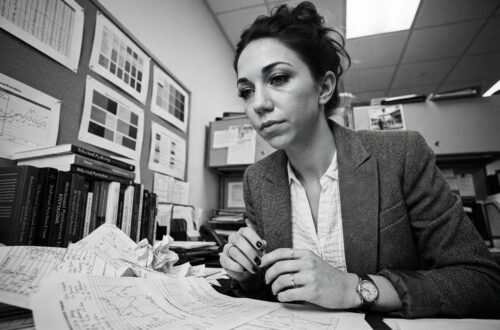

How An Essex Girl Ended Up Trusted With Other People’s Data
People still say it like a compliment. You do not seem like you are from Essex. As if the county were a rumoured condition and I had made a miraculous recovery. I usually smile, thank them for noticing I can conjugate a verb, and carry on. Internally I file it under the same heading as men who are surprised I have a first in mathematics. Mild, familiar, faintly exhausting.
I am from Essex. Chelmsford and Southend family roots, the kind of household that valued hard work and a proper night out in the same breath. Nobody at home treated intelligence as a personality you had to choose instead of pleasure. You could do the reading and still dance until your feet hurt. That was not a contradiction. It was just the week.
What I refused was the cartoon. Loud, orange, unintelligent, promiscuous, always one white stiletto away from becoming a punchline. I watched that version of us get sold back to the country for years and decided I would keep the warmth and drop the rest. I still compliment a stranger’s jacket. I will still start a conversation in a bathroom queue. I will not pretend to be thick so someone else can feel clever.
University of Essex, Colchester, Wivenhoe Park. Both degrees. A first-class BSc in Mathematics and then an MSc in Psychology, because one map of the world was never going to be enough. Campus was the perfect collision of serious study and student nightlife, and I did both without acting as if one cancelled the other. UV paint at Sub Zero in freshers’ week. FED Wednesdays after sports socials. Late library sessions that ended with a walk across the park at two in the morning because neither of us wanted the conversation to stop. A traffic-light party where I wore yellow on purpose and spent half the night talking about cognitive dissonance with a boy from my stats module. The colour code was doing less work than the conversation.
There was a lecturer, early on, who heard the mild Essex in my voice and treated it as evidence I might be less serious. He did it lightly, the way people do when they think they are being observational rather than rude. I outscored the room. I also kept the memory, not as a wound I decorate myself with, but as useful information. Underestimation is a kind of extra time if you refuse to spend it on proving you exist.
People imagine the jump from Essex nightlife to other people’s data as a redemption arc. It was not. I did not get clever as an apology for having enjoyed myself. I got trained. Proofs in the afternoon, a dress that made me feel like myself in the evening, Sunday lunches that turned into arguments about politics and then someone putting a record on. The spreadsheet brain and the ability to make someone feel at ease were never at war in me. Other people kept insisting they should be.
The job, now, uses both degrees. Behavioural data. Research. Applied psychometrics. The respectable sentence is that I help organisations understand what people do, not just what they say they do. The truer sentence is that I am trusted with patterns that belong to strangers. Clicks, delays, scores, survey answers given too quickly, the little avoidances that sit in a dataset like fingerprints. It is pattern recognition with consequences. That last word matters. A pretty model that flatters a client is not work. It is decoration.
Trust, in this field, is not a vibe. It is a chain of decisions. How the sample was built. What the question actually measured. Whether the missing data is random or a confession. Who gets to see the file. What happens when a finding is commercially convenient and humanly sloppy. I like the elegance of a clean analysis. I like it less when someone wants the elegance without the ethics.
There is a particular look people get when I tell them what I do. They expect either a lab coat or a girlboss monologue. I offer neither. I talk about probability the way other people talk about weather. I will say availability heuristic if that is the thing in the room. I will also say, more plainly, that one vivid story is not a trend. Humans are very good at turning a single late text into a theory of abandonment. Datasets are good at asking whether that story survives contact with the rest of the evidence. I find that calming. Not because feelings are silly. Because feelings deserve better than being bossed about by one noisy example.
Competence is not a personality. I wish someone had put that on a poster in every seminar room. Being good at this is closer to keeping a kitchen clean than it is to being a genius in a film. You check the assumptions. You name the bias. You do not fall in love with your first interpretation. You come back the next day and see whether the pattern still holds when you are less impressed with yourself. That is the daily practice I rather love. It has none of the glamour people attach to “data girl” and all of the satisfaction of knowing you did not invent a conclusion because it sounded sharp.
Warmth helps, which surprises people who think rigour has to come with a cold face. I am high in the traits that make rooms easier: socially fluent, curious, able to read a shift in tone before it becomes a problem. That is useful in research more often than the textbooks admit. Participants tell you better things when they do not feel like a specimen. Stakeholders listen longer when you can hold a finding and a human being in the same paragraph. Empathy without being a pushover is a professional skill. It is also just how I was raised. Essex warmth, refined, not performed. I will compliment the work. I will not swallow a bad brief because I want to be liked.
The cartoon version of an Essex woman is supposed to treat sex and feelings as sport. I treat both as meaningful and I am not embarrassed by either. That has nothing to do with the job except that it trained me early in the difference between performance and presence. You can tell when someone is collecting notches. You can tell when a company is collecting metrics in the same spirit. Volume without attention. Heat without care. I have no patience for it in bed and even less patience for it in a report. If you are going to look at people, look at them properly.
I notice micro-shifts. Attachment theory gave me language for that, which is both a gift and a nuisance. Anxious-secure leaning, if we are being precise. I crave depth and consistency. I can name my own patterns without drowning in them, most days. At work that sensitivity is an instrument. A stakeholder who says “we just need a simple story” is often asking you to flatten someone. A colleague who goes quiet after a finding can be protecting a budget or protecting a person. The data does not tell you which. The room sometimes does. The work is holding both sources of information without letting either become a fantasy.
There was a picnic by the lake on campus that started intellectual and ended with two people lying in the grass not talking. I think about that more than I think about any dashboard. Not because I want to make research romantic. Because the best thinking I have done has always had a body in it. You can be talking about free will and determinism for three hours and still notice the way someone listens. You can build a scale and still care whether the item wording humiliates the person answering it. Mind and body are not separate departments. Anyone who has ever got wet from competence already knows that. Anyone who has ever trusted a clumsy, kind first time already knows it too. The tenderness stays. The cinematic version rarely does.
I lost my virginity at eighteen in a way that was clumsy and kind rather than cinematic. I still remember the unexpected tenderness. That sentence does not belong in a methods section, and yet it belongs in the person who writes the methods section. I do not do performative cool girl. I will say I missed you and mean it. I will also say this sample is biased and mean that too. Emotional honesty and statistical honesty use the same muscle. You either tell the truth about what is in front of you or you dress it.
People assume that working with data makes you less romantic. It has done the opposite for me. Once you understand base rates, you become almost tender toward the rare good thing. A partner who remembers a detail from three conversations ago is not ordinary. A team that asks what the finding will do to the people behind the rows is not ordinary. Loyalty to close people. Intellectual play. Physical chemistry that actually means something. Self-possession. Those are values. They are also filters. They keep you from treating either sex or statistics as disposable.
Dry fact: a lot of bad research is just attachment injury in a suit. Someone wants certainty so badly they will torture a p-value until it agrees with them. Someone wants to be chosen by a client so badly they will bury the limitation in appendix nine. I recognise the hunger. I have over-analysed a delayed text and then laughed at myself for it. The difference is that in my own life I am allowed to be a bit ridiculous. In the work I am not allowed to pretend the longing is evidence.
Teaching myself out of the stereotype was not a single decision. It was hundreds of small refusals. I would not code-switch into slang to make a night out easier to narrate later. I would not dim the maths so a boy could enjoy the dress. I would not accept “you don’t seem Essex” as praise. I like nice things. Good hair. A well-cut dress. A hotel room with decent lighting. I am not materialistic in a flashy way and I am not vulgar and I am not dumb. Those sentences should not have to work this hard. They still do, occasionally, which is why I write them down.
The first time I realised I could hold a room with both a proof and a story, something settled. Until then I had been treating the two as separate costumes. Serious Nikki in the seminar. Warm Nikki on the seafront at Southend, heels in one hand, the sea looking theatrical after a messy, joyful night. They were always the same person. The room just needed permission to notice. Data work is like that too. The numbers are the proof. The interpretation is the story. If you only do one, you either bore people or mislead them. If you do both, they trust you with more.
Trust is the actual subject of this job, even when the brief pretends it is insight. Someone has handed you information that was never meant to be gossip. Survey answers about mood. Behavioural traces from an app opened at 1 a.m. Scores that can change whether a person is offered help, credit, a place, a second look. I do not get mystical about it. I get careful. Careful is unfashionable. Careful is also how you sleep.
There is humour in the seriousness if you stay close enough to ordinary life. I have sat in meetings where grown adults discussed “user journeys” as if people were trains. I have watched a model get praised for predicting the obvious at great expense. I have been asked to make a finding “more exciting” when the honest finding was that nothing much was happening. Excitement is not a statistical property. It is a sales hope. I can be funny about that without becoming cruel. Cruelty dressed up as banter is one of my dislikes. The data already contains enough human mess. It does not need me adding a sneer.
I count things when I am anxious. Tiles, steps, beats. It is a quirk and it is also very on brand. Counting returns you to what is actually there. The job is a more expensive version of the same habit. How many. How often. Compared with what. Under which conditions. The romance is not in the counting. The romance is in what the counting protects you from: the story that feels true because it is vivid, the stereotype that feels true because it is old, the compliment that is actually a little fence around where you are allowed to come from.
Essex coastline in winter still does something to me. Cold air, fewer performances, the place itself without the television version laid over it. I go home often. Family arguments about politics, then a record, then the particular relief of being known by people who were there before the degrees. They are not impressed in the way London is impressed. They are pleased I followed through. Conscientiousness looks glamorous on a CV. At home it just looks like doing what you said you would do.
A holiday where I read a paper on the beach and went out that night still feels like the correct shape of a life. I do not want a personality that can only operate in one lighting state. Applied psychometrics in daylight. Dancing until I am tired after dark. Long voice notes. Good questions. Remembering what you told me three conversations ago. Flirting that is intelligent and physical at the same time: I notice, I name it, I leave space. None of that is separate from the woman who checks a confidence interval. It is the same attention, pointed at different objects.
If you want the practical moral, here it is, without a bow on it. You can come from a place people make jokes about and still be the person they hand the sensitive file to. You can enjoy a night out and still love mathematical elegance. You can feel things deeply and still refuse to let neuroticism write the report. Moderate neuroticism, if we are doing Big Five like grown-ups. I feel it. I recover with self-awareness. That recovery is part of why I am safe with other people’s data. I know what projection looks like from the inside.
I am not a therapist and I am not a mascot for social mobility. I am a specific woman who happens to know both probability and the feeling of being new and possible on a sticky campus floor. The work followed from that combination, not from a desire to become respectable. Respectability is a weak ambition. Accuracy is better. So is kindness with a spine.
Sometimes a junior colleague asks how I got people to take me seriously. They want a trick. There is not one. You do the work until the work is harder to dismiss than your accent, your dress, or the county on your paperwork. You ask good questions. You admit uncertainty in complete sentences. You do not decorate a weak finding. You keep your warmth because warmth is not the opposite of rigour, no matter how many films have suggested otherwise. And when someone says you do not seem like you are from Essex, you let the sentence hang there for a second, like a badly fitted jacket, and then you get back to the pattern in front of you.
The pattern is usually more interesting than the stereotype anyway. People are. That is the whole job, once you strip the software and the job titles away. People, repeating themselves, surprising themselves, leaving traces. I kept the part of Essex that knows how to talk to a stranger. I dropped the part the country invented so it could feel superior. Two degrees later I am trusted with data that is really just other lives, compressed. I try to treat those lives the way I would want mine treated. Carefully. Warmly. Without turning them into a cartoon.
Competence, every day. Not as a performance. As a practice I rather love.

nikkiessex
I am Nikki. 40 years old. Essex-born. I trained in mathematics and psychology, then made a living in behavioural work: people, patterns, the quiet data underneath what we say we want. I teach the same things I write about. How minds lean. How loyalty shows up after the row. How to keep a clear head without going cold. I have been writing on the internet for five years. Not as a brand exercise. As a way of thinking in public. If you are new, start with the pieces that feel like a table you already know. I will meet you there.


You May Also Like

Probability At Work When Everyone Else Is Guessing Loudly
Teaching Consent As Curiosity, Not A Legal Afterthought