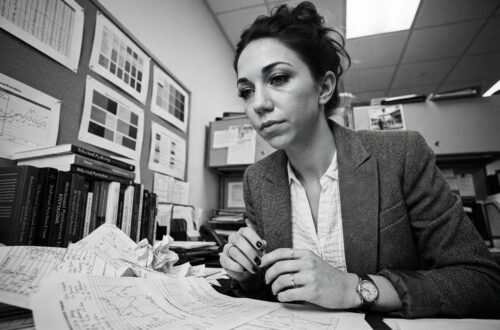

Being Underestimated At Work And Using It Like Extra Time
I still notice it in the first thirty seconds. Not always a comment. Sometimes it is only a tiny recalibration in someone’s face, the sort of micro-shift I get paid to clock in other people and would rather not have to clock in a meeting about confidence intervals.
Essex.
They hear the soft edge of it, or they see it on a form, or they get there by some private geography of their own, Chelmsford, Southend, a night out they once had that they now use as evidence. Then the bar comes down. Not dramatically. Just enough that you can hear it happen if you have been listening for it your whole adult life.
Fine.
I used to waste energy trying to head it off. I would arrive over-prepared in the wrong direction, sanding my vowels, naming the degrees too early, making sure everyone knew I read journals for pleasure like that was a personality. It made me smaller and it did not even work. People who want a cartoon will find a cartoon. The better move, the one I actually use now, is almost embarrassingly simple. Let them underestimate you. Then use the extra time.
That sounds passive if you say it quickly. It is not. It is a work habit. It is also, if I am honest, a little bit of sport.
I grew up with a family that valued hard work and a good night out in the same week, which is a combination some people still treat as a contradiction. Sunday lunch could turn into an argument about politics and then someone would put a record on and the argument would have to sit down. Nobody in my house thought intelligence was a costume you put on for London. They also did not think enjoying yourself made you unserious. I watched the Essex girl jokes anyway. TOWIE-era stuff. Loud, orange, thick, available. I was none of those things and I still felt the heat of the stereotype when a lecturer, early on, treated the mild accent I used to have as if it meant I would need the proof explained twice.
I outscored the room.
I remember the quiet pride of that more clearly than I remember his face. Wivenhoe Park at the ugly time of year, the library lights doing that unflattering thing they do after midnight, the knowledge that I could hold a room with a proof and a story if I wanted to. University of Essex was useful for that collision. Serious study. Student nightlife. You could do both without pretending one cancelled the other. UV paint at Sub Zero in freshers week did not make the maths less true in the morning. A traffic-light party where I wore yellow on purpose and then talked about cognitive dissonance with a boy from my stats module did not make me less likely to get a first. The people who need those things to cancel each other are usually the same people who lower the bar when they hear where you are from.
I have a first-class BSc in Mathematics and an MSc in Psychology. I say that here because it belongs to the story, not because I enjoy reciting qualifications like a security code. The job I do now uses both. Behavioural data. Applied psychometrics. Research that tries to measure what people actually do rather than what they claim they do in a survey they filled in while half watching something else. It is not glamorous in the way people want jobs to be glamorous. There are models. There are messy datasets. There are meetings where someone uses the word insight as if it were a scent. There is also, often, a moment when a person looks at me and decides I am the warm one, the approachable one, the girl who will make the findings sound nice, and not the person who built the thing.
I let that happen for a minute.
Then I ask a precise question.
It is astonishing how quickly a room rearranges itself around a good question. Not a performance question. Not the kind designed to prove you read the paper. A question that reveals you have already done the work they assumed you had not. Why that baseline. Why that exclusion rule. What happens to the effect size if you stop treating missingness as random. I keep my voice even when I ask it. Even is important. Warmth is allowed. Heat is not useful in that moment. If you sound triumphant, you give them a new story: the chippy Essex girl making a point. If you sound calm, they have to deal with the content.
The model helps. I mean that almost affectionately. A well-built model does not care about your postcode. It does not care if you like a well-cut dress and decent hotel lighting and dancing until your feet hurt. It will either hold or it will not. I have a low tolerance for being looked down on because of where I grew up, and I have an even lower tolerance for sloppy method. Those two facts get on rather well. When someone underestimates me, they often also underestimate the standard I am about to apply. That is the extra time. While they are still locating me socially, I am already inside the numbers.
People talk about imposter syndrome as if it were a personality. Sometimes it is just a reasonable response to a room that keeps handing you the wrong script. Anxious-secure leaning, if we are going to be accurate about it. I notice tone. I notice who gets interrupted. I can overthink a delayed email and then laugh at myself for doing the attachment theory special on a calendar invite. I also recover. Self-awareness is not the same as drowning. At work, the useful version is this: I can feel the slight of being underestimated and still not organise my entire performance around correcting it in public. Correction is better when it arrives as competence.
There is a particular kind of man, and occasionally a particular kind of woman, who will compliment your manner as a substitute for engaging with your output. Lovely energy. So easy to work with. Really brings people with her. All of that can be true. I am high in extraversion and agreeableness and I am not going to pretend otherwise. I will compliment a stranger’s jacket. I will start a conversation in a bathroom queue. I am good at reading a room. That does not make the regression less mine. The trick is not to refuse warmth so you can be taken seriously. The trick is to stop offering warmth as a plea. I like being pleasant. I do not like being digestible.
Dryly, the stereotype did give me one professional advantage. People who expect you to be unintelligent often explain things they should not explain. They narrate the obvious. They leave longer pauses. They send the draft with comments written for a junior. That is information. It tells you where the underestimation lives. It also gives you a map of what they think the work is. If their explanation is thin, the work they are protecting is probably thin too. I take notes. I go home to Essex often enough that I have not forgotten how to be direct when it matters. Directness is not the same as volume. You can say, quite mildly, that the construct validity is not doing what they think it is doing. Then you sit there and let the silence do some of the labour.
I count things when I am anxious. Tiles. Steps. Beats in a song through a wall. It started as a private habit and became, accidentally, good training for a job that is mostly structured attention. Underestimation spikes the counting. I notice that now and I do not treat it as a verdict on my ability. It is just the nervous system doing what nervous systems do when status is in the room. Probability helps. The odds that one person’s first impression is a complete account of my mind are, generously, rubbish. The odds that a clean piece of analysis will still be standing after their first impression has left the building are much better. I work for the second number.
There was a phase, after the MSc, when I thought the solution was to become unmarked. No origin. No texture. Just the work, floating in a mid-Atlantic professional voice, as if I had been grown in an open-plan office. It felt like safety and it felt like a small death. I like nice things. Good hair. A dress that makes me feel like myself. I am not materialistic in the flashy way people want from the stereotype, and I am not going to sand myself down into a person with no evenings. I still love a proper night out. Chelmsford into a club that probably should not have survived as long as it did. Southend seafront after, cold air, heels in one hand, the sea looking theatrical because you have earned the morning. That girl and the woman who can talk about psychometrics are the same person. If a workplace needs them split, the workplace is the problem.
Using underestimation as extra time has rules, or it becomes a coping mechanism with better branding.
First, you actually have to be ready. This is not a film in which the overlooked girl wings it and then everyone claps. I am conscientious enough to have two degrees and I did not get them by hoping the room would feel warm toward me. If they lower the bar, I do not meet them there. I use the gap to check the thing they did not check. I read the appendix. I look at the sampling frame. I ask what the instrument is actually measuring when it says confidence or engagement or risk. Most people are not underestimating you because they have run a careful analysis of your intellect. They are pattern-matching. You can beat pattern-matching with preparation so dull it becomes a kind of elegance.
Second, you do not perform gratitude for being included. I am not grateful to be in a meeting I am qualified to run. Politeness, yes. The soft little thank you that women are trained to sprinkle over their own expertise, no. That one took practice. I still hear it trying to come out when someone is surprised I can do the hard bit. Surprise is their emotion. I do not have to host it.
Third, you choose your corrections. Not every slight is worth the calories. Some people will always hear Essex and think less. You can spend a career trying to educate them out of a bias they are getting something from. I would rather outscore them and go to lunch. There is a difference between self-possession and turning your working life into an outreach programme for other people’s class assumptions. I like teaching. I like making psychology and probability usable for people who are not trying to win a seminar. I do not like unpaid emotional labour dressed up as being a good sport.
Fourth, you let the work be visible. This one matters more than the voice. If you only ever save the situation quietly, people remember the situation and not you. I used to do that. Fix the model, tidy the story, hand it back looking inevitable. Inevitable work has no author. Now I will say, without theatre, that I changed the scoring, or that I rebuilt the scale, or that the finding only appears if you stop collapsing two very different behaviours into one cheerful metric. Being underestimated once is annoying. Being repeatedly useful and unnamed is how annoying becomes a career.
I should admit the part that is not only strategy. There is a flash of satisfaction when the room catches up. I am not above it. High openness, high extraversion, a pleasure-seeking streak I have no intention of apologising for. Of course there is a small, private yes when someone who thought they were simplifying for me has to rewrite their sentence. I keep it off my face. Triumphant faces give people an escape route. They can call you aggressive, or a bit much, or not a team player, which are all popular translations of a woman being correct in public. Even voice. Let the model speak. Go home and tell the people who actually know you.
The people who know you are the point, in the end. Loyalty to close people is one of my actual values. Work can be intellectually beautiful and still not deserve the whole of you. I want emotional honesty, intellectual play, physical chemistry that means something, and a life in which I am not performing stupidity so that someone else can feel tall. Being underestimated at work used to hook the anxious part of me, the part that notices every shift and starts writing a theory. It still does, sometimes. Then I laugh at myself, because I can name the pattern, and I go back to the thing I can control.
Which is the work.
A first date that became a three-hour conversation about free will and determinism taught me something I now use in offices. People reveal whether they can stay with difficulty. Some want the vibe of intelligence. Some want the labour of it. Underestimation is often just a person reaching for the vibe. They have a story about Essex, or about women who dress as if they enjoy their own bodies, or about warmth being the opposite of rigour. You cannot always stop them starting that story. You can make the story expensive to keep.
I think about probability in ordinary places. The chance that a hiring panel’s first five minutes are a fair test. The chance that the loudest person in the stand-up understands the limitation of the measure. The chance that you will change a committed underestimator versus the chance that you will simply do excellent work in front of them until their opinion becomes socially awkward to maintain. I bet on the last one more often than I used to. It is slower. It is also cleaner. Cruelty dressed as banter still exists. Pretension still exists. People still treat psychology as a party trick and maths as a personality they can rent for a quarter. I dislike all of that. I do not have to become harsh to refuse it.
There is a version of this advice that turns into armour, and I do not want that either. I am not a stereotype and I am not a therapist and I am not a machine for producing unbothered women. I feel things deeply. I want to be chosen, not just found useful. At work that translates into a preference for colleagues who can match me intellectually without needing me to arrive pre-shrunk. If they can do that, the Essex thing becomes texture. If they cannot, it becomes their tell.
I keep a private list of nights that felt like they changed the weather inside me. I do not keep an equivalent list of every time I was underestimated, because that list would be long and a bit sad and I refuse to organise my memory around other people’s failures of imagination. I remember the useful ones. The lecturer. The meeting where I asked about the missingness and watched a theory collapse politely. The first time I realised I could be the person who made someone feel at ease and the person who found the error. Both. In the same afternoon.
If you want something practical, here it is, without the life-coach shine.
Do the unglamorous preparation before they have decided what you are. Arrive knowing the limitation of your own analysis, because nothing disarms a patronising question like you asking a sharper one of yourself first. Dress in a way that makes you feel like yourself, not in a way designed to soothe their category system. Speak in complete sentences. Ask the question that shows you read the bit they skipped. Then stop talking long enough for the room to catch the implication. Do not fill the silence with a joke at your own expense. Self-deprecation is often just underestimation with better manners.
When they say you do not seem like you are from Essex, do not thank them. That sentence is not a compliment. It is a confession that they think the place is a punchline and you have been granted an exemption. I like the coastline in winter. I like going home. I like the particular warmth of making friends in the ladies and never seeing them again. I also like mathematical elegance and a well-structured argument and being read accurately. These things have always been allowed to coexist. The fact that some workplaces still act surprised is not my identity crisis.
Being overlooked once is annoying. Being ready is better. The extra time is only extra if you spend it on the work rather than on the wound. I still notice the lowered bar. I still feel it. Then I let them have their little story for a minute, and I use the minute. By the time they look up, the model is already speaking, and my voice is still even, and I am already thinking about lunch.

nikkiessex
I am Nikki. 40 years old. Essex-born. I trained in mathematics and psychology, then made a living in behavioural work: people, patterns, the quiet data underneath what we say we want. I teach the same things I write about. How minds lean. How loyalty shows up after the row. How to keep a clear head without going cold. I have been writing on the internet for five years. Not as a brand exercise. As a way of thinking in public. If you are new, start with the pieces that feel like a table you already know. I will meet you there.


You May Also Like

What Behavioural Research Quietly Teaches You About Desire
The Quiet Glamour Of Being Good At Invisible Work