

Probability At Work When Everyone Else Is Guessing Loudly
I have sat through meetings where the loudest person in the room was also the least acquainted with a sample size. It is a talent, of sorts. They lean back. They say they are confident. They use words like obvious and definitely and everyone knows. The slide behind them has a chart that would not survive a first year statistics seminar, and still the room nods, because confidence is contagious in the way a cold is contagious. You catch it before you have checked whether you should.
I prefer odds.
That sentence has got me into trouble more than once. People hear it and decide I am the dampener, the woman who will not get on board, the one who ruins the vibe by asking what the base rate is. I am not trying to ruin anything. I am trying not to build a strategy on a feeling that dressed itself up as a fact. There is a difference, and offices are strangely committed to pretending there is not.
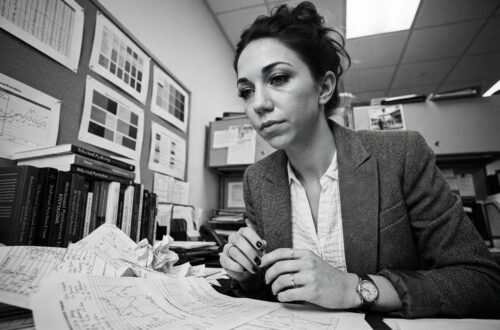
I work in that odd seam between mathematics and minds. Behavioural data. Applied psychometrics. The unglamorous business of asking what people actually do, rather than what the most charismatic person in the meeting needs them to have done. It is not a cold job, whatever people imagine when they hear the word model. It is a job about patterns with consequences. If you get the pattern wrong, you do not just look silly. You spend money, you misread a customer, you tell a team a story that will not hold when the next quarter arrives and the story has nowhere left to hide.
Offices love confidence because confidence is quick. Probability is slower. Confidence can be performed in a single sentence. Probability asks you to sit with uncertainty long enough to notice whether you have earned the right to be sure. That is not a personality defect. It is the whole point of having a maths brain in a room full of narratives.
I grew up in Essex, in a family that valued hard work and a good night out, and I watched enough jokes about girls like me to know how quickly a room will decide you are decorative. University of Essex, Colchester, two degrees, first class in mathematics and then psychology, and still I have had the experience of a man explaining my own slide back to me with the gentle patience of someone helping a child with a menu. I smiled. I asked him which part of the confidence interval he wanted to revisit. Warm first. Sharp when it matters. The interval did not become more impressive because he spoke louder.
There is a particular office superstition that certainty is leadership. I do not buy it. Leadership, if it is worth anything, is the ability to say I do not know yet without the room treating it as a confession. The best people I have worked with can hold two things at once: a direction of travel, and an honest account of how much evidence is under their feet. The worst people I have worked with can hold only one thing, which is the sound of their own conviction bouncing back at them.
Let me be plain about what I mean by probability at work, because the word makes some colleagues glaze over as if I have started reciting a shipping forecast.
You are not predicting the future like a magician. You are saying, given what we know, how often does this sort of thing happen, and how much should we update now that we have seen this new piece of information. That is it. That is the whole romance of it. Bayes is not a lifestyle. It is a habit of not falling in love with your first explanation.
A classic meeting goes like this. Someone has run a small pilot. Eleven people clicked. Eight of them converted, or said they would, or hovered in a way that could be interpreted as intent if you are already fond of the idea. The person who commissioned the pilot would quite like to scale it nationally by Thursday. They have already named the campaign in their head. They have already imagined the applause. At that point the data is not being read. It is being used as a prop in a play that was cast last week.
I will ask about the base rate. Not because I enjoy watching faces fall, although I will admit there is a tiny, private pleasure in it. I ask because eight out of eleven means almost nothing until you know what usually happens. If your ordinary conversion sits at sixty percent, you have not discovered a miracle. You have discovered a Tuesday. If your ordinary conversion sits at twelve percent, then yes, perhaps we should lean in. Even then I want to know who those eleven people were. Friends of the brand. Staff. A sample so tidy it would make a first date look chaotic. Selection effects are the office equivalent of only asking your most charming friends whether you are good company.
People hear that and think I am being difficult. I think I am being loyal. Loyal to the work, and to the people who will have to live with the decision when the pilot stops being a darling and starts being a budget line.
There is also the confidence interval problem, which I wish more workplaces would treat as a social skill rather than a technical one. A point estimate looks decisive. Seventy two percent. Beautiful. Print it big. The interval around it might run from fifty one to eighty nine, which is not a finding so much as a shrug in a nice font. If you only present the seventy two, you are not lying in the criminal sense. You are lying in the hospitality sense. You have served a thin soup in a very handsome bowl.
I stay warm when I say this. That part matters. There is no prize for being the cleverest person in the room if you make everyone else feel stupid on the way through. I do not want a culture where only the stats people are allowed to speak. I want a culture where a designer can say I have a hunch, and then we can ask what would have to be true for that hunch to survive contact with a proper sample. Hunches are not the enemy. Unexamined hunches with a launch date attached are the enemy.
Dry humour helps. I have found that if you tell a room their favourite graph is doing the can can on a sample of fourteen, they hear you better than if you say the estimate is unstable. Same information. Less sermon. I am not above a joke if the joke keeps the dignity of the work intact. What I will not do is laugh along with the version of banter that treats caution as a feminine vice. I have sat through enough of that to recognise the flavour. She is overthinking it. She is risk averse. She is not commercial enough. Translation: she noticed the hole in the boat and declined to clap while we sailed into it.
I do overthink attachment in my private life. I will own that. A delayed text can still send my mind off on a little tour of every cognitive bias I have ever taught other people to avoid. Availability heuristic, hello, you again. One silence becomes a pattern because the mind is theatrical and I am not made of stone. At work I try to apply the same self awareness I use on myself at midnight. Noticing a feeling is not the same as obeying it. The office version of that is noticing a narrative and refusing to let it hire staff.
University taught me both halves of this. Late library sessions that turned into walks across Wivenhoe Park because neither of us wanted the conversation to stop, and then, the next morning, a stats seminar where the point was not to sound brilliant but to be less wrong than yesterday. I liked that collision. I still like it. You can hold a room with a proof and a story. You do not have to pick one identity and live inside it like a costume.
The first time a lecturer treated my then milder Essex accent as if it meant I was less serious, I did the least dramatic thing available. I outscored the room. I am not precious about that memory. I am precise about it. Underestimation is information. It tells you who is listening to the content and who is listening to the packaging. In meetings now I sometimes let the packaging work in my favour for a minute. People relax when they think they have placed you. Then the model arrives, and the model does not care where you grew up.
Probability at work is also about knowing when not to update.
That sounds contrary, I know. The whole Bayesian fairy tale is that new evidence should move you. Yes. Good evidence should. A loud anecdote should not. One furious customer is not a market. One glowing email is not product market fit. One senior stakeholder who had a thought in the shower is not a research programme. If you update on every vivid story, you are not scientific. You are suggestible with a laptop.
I keep a private rule that would look petty written on a whiteboard and still saves me hours. If a claim would change a decision, it needs a sample that could have gone the other way. If the evidence was collected in a manner that made the preferred answer almost inevitable, it is not evidence. It is set dressing. You can still like the idea. Like it as an idea. Do not baptise it with a percentage.
There is a kindness in this, which people miss because they think numbers are a way of withholding permission. I think the opposite. Guessing loudly is unkind. It sends junior colleagues off to build things that were never going to work. It burns trust with customers who were asked the wrong question. It wastes the quiet people who did the unfashionable graft of cleaning the data. When I refuse a story the numbers will not carry, I am not trying to win. I am trying not to spend other people’s effort on my colleague’s adrenaline.
And yes, I like nice things. A well cut dress. Good hair. A hotel room with decent lighting. I do not accept the idea that a woman who enjoys those also has to perform intuition as her only mode of intelligence. Pleasure and precision can share a diary. I can dance until my feet hurt on a Chelmsford night and still come in on Monday and ask whether we pre registered the analysis. Those are not opposing personalities. They are one person who declined to be simplified.
Let me teach the useful bit, because otherwise this is just me complaining about meetings, and I can do that for free in a taxi queue.
First, separate belief from decision. You can believe a product is beautiful and still decide not to scale it until the interval narrows. Belief is allowed to be warm. Decisions should be colder than the story you told at lunch.
Second, ask what would change your mind before you look at the result. If the answer is nothing, you are not doing analysis. You are doing confirmation with extra steps. I have watched grown adults discover, with genuine surprise, that they had already decided. The graph was only there to provide costume jewellery for the decision.
Third, talk about variance as if it were a person in the meeting. It is. It sits there, uninvited, altering the meaning of every average. Two teams can have the same mean score and completely different lives underneath it. One is steadily fine. The other is a carnival of extremes. If you only manage to the mean, you will soothe the wrong problem and miss the one that bites.
Fourth, be suspicious of the word significant when it is doing social work rather than statistical work. In a meeting, significant often means I would like this to matter now. In a model, it means something narrower, and even then it can be a small effect wearing a large sample like a borrowed coat. Effect size, practical importance, cost of being wrong. Those are the adult questions. P values are not a personality.
Fifth, keep the human in the loop without letting the human steamroll the loop. Behavioural data is full of people. Tired people. Hopeful people. People who click yes because the button was green and they wanted the survey to end. If your psychology training was worth the fees, you know that measurement is messy. That does not give you permission to throw measurement away. It gives you permission to measure more carefully, then speak more modestly.
I will give you an example without naming the company, because I like my job and I like sleeping.
We had a claim that a small change in wording would lift completion rates in a questionnaire. Someone important liked the new wording because it sounded warmer. Warmth is not nothing. I like warmth. I use it. We tested it properly instead of anointing it. The warmer version did lift completion in one segment and flattened it in another. If we had rolled the charming sentence out to everyone, we would have congratulated ourselves with a blended number that hid a loss. The blended number is how offices get drunk. It tastes like success and then you wake up with a headache in the subgroup you forgot to check.
That is applied psychometrics when it is behaving itself. Not a trick. A refusal to let an average become a lullaby.
People ask me whether this way of thinking makes me less brave. I do not think so. Bravery that ignores base rates is just volume. I will take a calculated risk. I quite like a calculated risk. I like nights that start as dancing and become the first time you ask for exactly what you want. I like a first date that was supposed to be drinks and turned into three hours on free will and determinism because neither person wanted to go home. I am not allergic to leaping. I am allergic to leaping while shouting that the ground is definitely closer than it looks.
There is an attachment flavour to all this, if you want the psychology in the room as well as the maths. Some teams have an anxious relationship with being right. They need the result to love them back immediately. Other teams avoid looking at the data at all, which is the avoidant version of the same fear. I lean anxious secure, which at work means I notice the micro shift in a stakeholder’s tone when the graph does not flatter their idea. I can feel the temperature drop. I do not have to marry the feeling. I can name it, stay kind, and keep the question on the table. What would good evidence look like. Not what would make you feel soothed before lunch.
I count things when I am anxious. Tiles. Steps. Beats in a song. It is a quirk, not a brand. At work the respectable version of that quirk is checking the denominator twice. Who is in the sample. Who is missing. Who never had a chance to appear. Missingness is not a technicality. It is often the most honest part of the dataset, the part that tells you whose lives were too busy, too sceptical, or too uninvited to show up in your tidy little dashboard.
If you want a positive article, here is the positive part, and I mean it.
You do not have to become a colder person to become a clearer one. You can compliment a stranger’s jacket and still reject a forecast that is doing cardio on a sample of twenty. You can be generous in a meeting, remember what someone told you three conversations ago, and still say I do not think we can carry that claim yet. Warmth is not the opposite of rigour. Warmth without rigour is just atmosphere. Rigour without warmth is a way of winning arguments and losing rooms. I am not interested in either half on its own.
The culture I want is simple enough to sound naïve and still, in my experience, rare. Ask better questions. Reward the person who brings a narrower interval, not just the person who brings a bigger promise. Let junior staff see you change your mind in public when the evidence moves. That last one matters more than any framework. If the only people allowed to be uncertain are the people with no power, you have not built a research culture. You have built a court.
I think about teaching this the way I think about teaching anything I actually care about. Do not dump the backstory. Do not perform intelligence. Give people a tool they can use on Thursday. So here is the Thursday tool.
When someone says they are confident, ask confident relative to what. Prior belief. Sample. Alternative explanation. Cost of error. If they cannot answer those, they are not confident. They are hopeful with good posture. Hope is allowed. It is even attractive. I like people who want things. I am a hopeless romantic in more than one direction. I still want the hope to sit next to a number that could have disappointed us.
When someone says the data shows, ask which data, collected how, from whom, over what window, and what was thrown away. Thrown away is the tell. Every dataset has a graveyard of exclusions that seemed reasonable at the time. Sometimes they were. Sometimes they were a quiet method for making the world tidier than it is.
When someone says it is obvious, treat obvious as a claim about shared priors, not about truth. If it is obvious only to people who already wanted the same ending, you have a club, not a finding.
I can be funny about this because otherwise it becomes a lecture, and I have no interest in becoming the office therapist with a calculator. I am not a therapist. I am a specific woman who happens to know both the spreadsheet brain and the bit where a conversation turns from clever to honest. Those two skills are cousins. In a date, you notice whether someone is listening to your face as much as your story. In a meeting, you notice whether someone is listening to the uncertainty as much as the headline. Same muscle. Different lighting.
There will always be a person who guesses loudly. They are not going anywhere. Some of them will get promoted, because volume is still mistaken for vision in too many buildings with badge access. That is irritating. It is also not an instruction for you to abandon your standards and start shouting. The work still needs people who can stay warm and refuse the fairy tale. If that makes you less immediately beloved than the colleague with the big hands and the bigger adjectives, so be it. Being chosen for accuracy is a slower form of being chosen. I will take it.
I go home to Essex often enough to remember that intelligence was never the rare resource. Permission to use it without apology was. A Sunday lunch can turn into an argument about politics and then someone puts a record on and the argument becomes a family again. Workplaces could learn from that. Disagreement does not have to be a personality contest. It can be two people trying, in good faith, to be less wrong before the next train home.
So no, I am not going to perform certainty I have not earned. I will give you the odds I can defend. I will tell you where the ice is thin. I will keep my voice kind while I do it, because there is no need to humiliate a person for wanting a clean story. We all want a clean story. I wanted one the first week of Freshers, UV paint at Sub Zero, sticky floor, the feeling of being new and possible. That feeling is gorgeous. It is also not a methodology.
Possibility is a wonderful prior. Update it like an adult.
If the numbers will not carry the story, I will not carry it for them. I will not sneer. I will not make a speech about integrity that makes everyone stare at their laptops. I will ask one good question, then another, and I will leave space, which is how I flirt and how I work and how I stay myself in rooms that would quite like a simpler woman.
Offices can keep their loud guesses. I will keep the odds, the dress that makes me feel like myself, and the right to say not yet. Not yet is not no. Not yet is how you stay in love with the work without lying to it.

nikkiessex
I am Nikki. 40 years old. Essex-born. I trained in mathematics and psychology, then made a living in behavioural work: people, patterns, the quiet data underneath what we say we want. I teach the same things I write about. How minds lean. How loyalty shows up after the row. How to keep a clear head without going cold. I have been writing on the internet for five years. Not as a brand exercise. As a way of thinking in public. If you are new, start with the pieces that feel like a table you already know. I will meet you there.

You May Also Like
Why People Patterns Pay Better Than Perfect Spreadsheets Ever Could

Being Underestimated At Work And Using It Like Extra Time